

Automatic decantation without electrical power
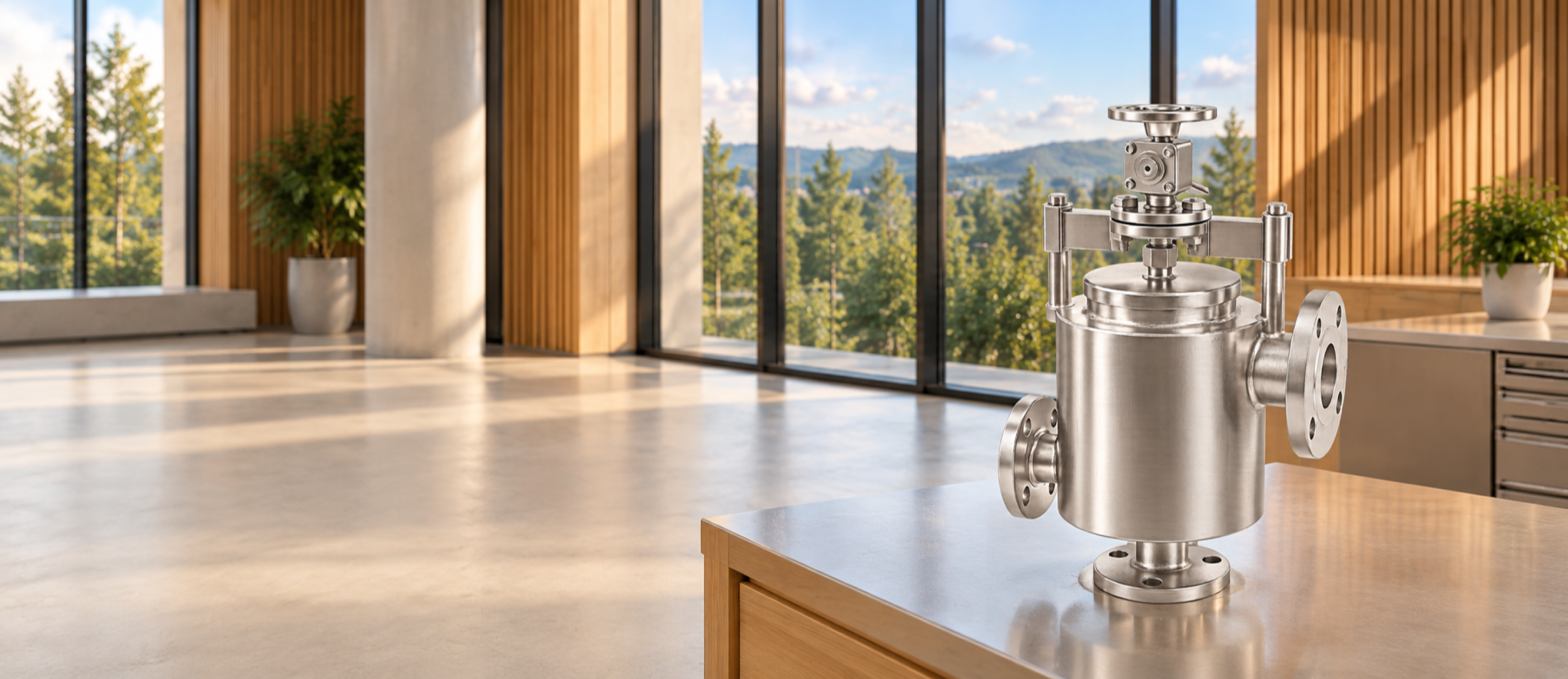
The Belfield automatic decantation valve uses a calibrated internal float to detect the transition between separated liquid phases. It remains open while the heavier phase drains, then closes mechanically when the lighter phase reaches the valve.
Simple mechanics. Reliable separation.
The Belfield Valve uses a weighted internal float to sense the change from one liquid phase to another. It remains open while the heavier phase is discharged, then closes automatically as the lighter phase reaches the valve.
- Separates liquids with an average specific-gravity difference as low as 5%
- No electrical supply, control panel or external sensor is required
- Self-cleaning, high-velocity turbulent flow across the seat
- Suitable for gravity-fed and pumped installations
Engineered for dependable industrial duty
No electrical supply, external sensor or control panel is required.
Engineered for industrial duty
75 psig
Standard design pressure for dependable industrial decantation across routine liquid-separation duties.
112.5 psig
Hydrostatic test pressure verifies pressure integrity before commissioning and supports dependable service.
Up to 95°C
Higher-temperature duties up to 95°C are accommodated with the appropriate capacity adjustment for reliable service.
HOW THE BELFIELD VALVE WORKS
Six stages. One automatic separation cycle.
The Belfield mechanism follows the liquid interface and closes automatically when the lighter phase reaches the valve.

01. Prepare the valve
Confirm the valve, line and downstream route are ready for the separation duty.

02. Open the inlet
Allow the settled heavier phase to enter the valve chamber.

03. Vent and fill
The float responds as the chamber fills with the heavier liquid.

04. Equalise the chamber
The mechanism tracks the phase interface through specific gravity.

05. Discharge the heavier phase
The separated heavier phase flows through the high-velocity outlet.

06. Automatic shut-off
The valve closes as the lighter phase reaches the float mechanism.

One valve, built around demanding separation duties.
01.
Specific-gravity sensing
Automatically separates the heavier liquid phase after two immiscible liquids have settled.
02.
5% average detection
Responds to small differences in specific gravity, typically around 5% on average depending on the application.
03.
75 psig design pressure
Designed for service pressures up to 75 psig and factory tested to 112.5 psig.
04.
Carbon or stainless body
Available with a carbon steel or stainless steel body, with stainless steel internal components.
05.
Self-cleaning high velocity
A turbulent, high-velocity flow path helps keep the seat clean during discharge.
06.
UK application support
Application selection and technical support are provided by Process Measurement & Analysis in West Yorkshire.

View our online brochure or manual
Explore the Belfield Valve in more detail, including its operating principle, construction, performance and the applications best suited to this proven decantation technology.
Let’s talk about your application.
Speak to the PMA team about your Belfield Valve requirements. Tell us about your liquid-separation duty, and we’ll help you find the right next step.
- Advice for your application. Discuss the liquids, flow rate and operating conditions for your process.
- Practical valve support. Get help with sizing, installation, maintenance and replacement parts.
- Clear next steps. Request a quotation or a callback, with your site and application in mind.
- An enquiry, not a mailing list. Your details are used to respond to your enquiry.
Belfield Valve customers






Prefer to speak with us?
You can also email sales@pma.uk.com.
Tell us how we can help
Share your requirements below. All fields are required.
Your enquiry goes directly to our team. Your details are used to respond to you. Read our privacy policy.