

Tank Dewatering
Drain settled water from storage tanks and retain the lighter product with an automatically closing, specific-gravity-operated Belfield Valve.
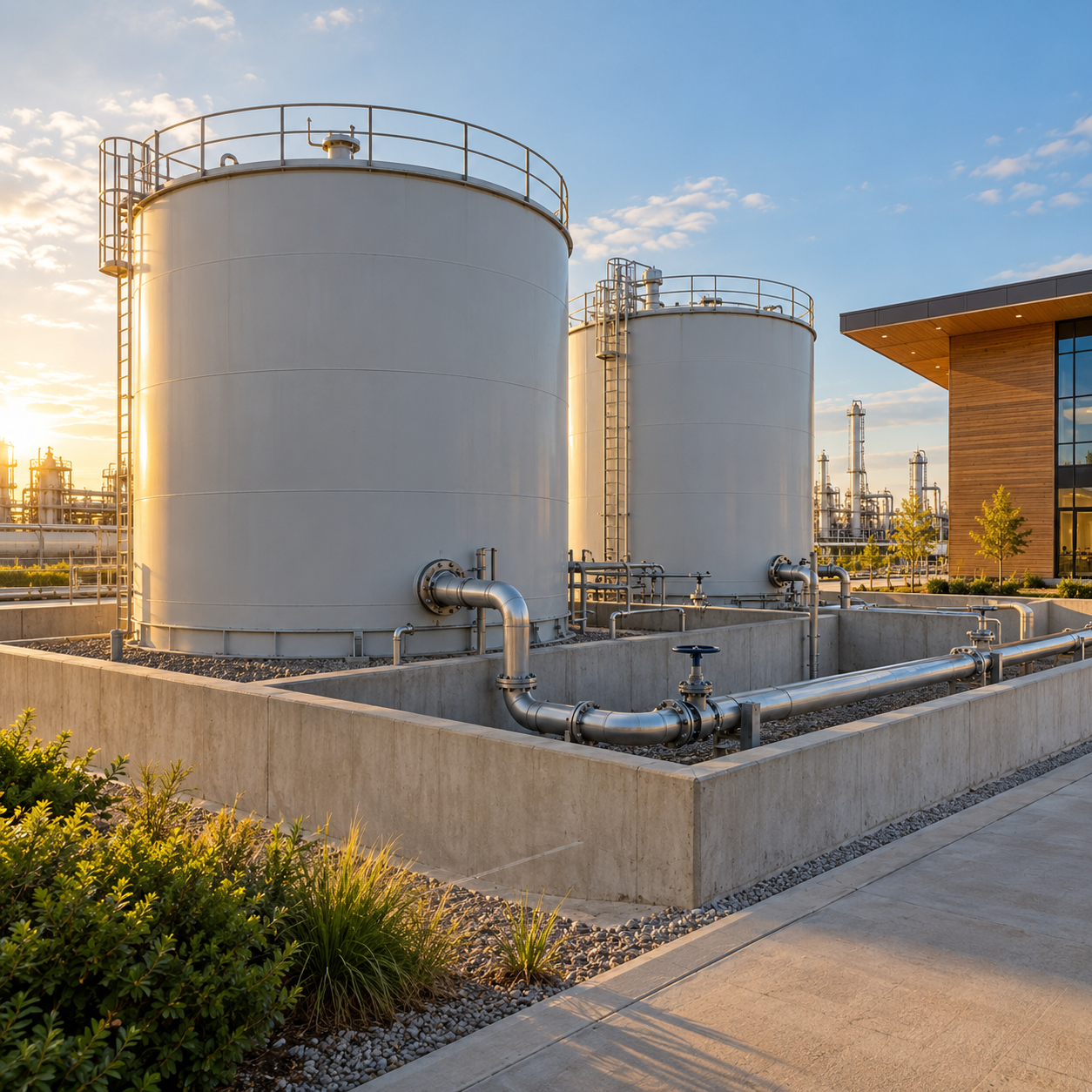
Automatic Tank Dewatering Valve
Remove Settled Water at the Tank
Water can accumulate beneath oil in storage and reclaimed-product tanks. Once the phases have settled, the Belfield Valve discharges the heavier phase and closes as the lighter phase reaches its float. The mechanism requires no electrical supply at the valve.
How the Process Works
01
Allow the liquids to separate in the vessel.
02
Discharge the heavier phase through the correctly selected valve.
03
Close the outlet as the lighter phase reaches the float.
Operating principle: settled phases reach the float in sequence. This is not an inline mixer or an emulsion-treatment system.
Manual or Automatic Drainage?
Manual drainage depends on an operator recognising the interface and closing the outlet. Mechanical decantation responds to the specific-gravity change at the valve. It can reduce routine intervention, but inspection, safe operating procedures and application-specific commissioning remain necessary.
Check the Whole Drainage Duty
Provide both liquid properties, operating temperature, viscosity, solids, required drainage rate, available head and pipework. Stable emulsions, wax, close-density liquids and pump-fed arrangements require particular review. The valve must not be selected from connection size alone.
Process-Data Checklist
- Liquid identities, density and viscosity at operating temperature
- Minimum, normal and maximum temperature and pressure
- Required flow, available head and downstream conditions
- Solids, emulsions, wax or flashing risks
- Connection sizes, materials and a vessel or P&ID sketch
Common Application Questions
Does it separate an oil-water emulsion?
No. The phases need to separate before they reach the valve. An emulsion or continuously mixed stream may require a different treatment process.
Is tank-bottom drainage the same as roof drainage?
No. Tank-bottom drainage removes settled water beneath the product. Floating-roof drainage removes rainwater through a separate drain route and needs its own reviewed arrangement.
Prepare Your Enquiry
Review the brochure and operating manual, then send your process data and a vessel or piping sketch to PMA.
Related Applications and Guidance
Floating Roof Drain Protection
Valve Sizing and Selection
Let’s talk about your application.
Speak to the PMA team about your Belfield Valve requirements. Tell us about your liquid-separation duty, and we’ll help you find the right next step.
- Advice for your application. Discuss the liquids, flow rate and operating conditions for your process.
- Practical valve support. Get help with sizing, installation, maintenance and replacement parts.
- Clear next steps. Request a quotation or a callback, with your site and application in mind.
- An enquiry, not a mailing list. Your details are used to respond to your enquiry.
Belfield Valve customers






Prefer to speak with us?
You can also email sales@pma.uk.com.
Tell us how we can help
Share your requirements below. All fields are required.
Your enquiry goes directly to our team. Your details are used to respond to you. Read our privacy policy.