Inside a storage tank, gravity usually does the first part of the job. Given sufficient settling time, water moves towards the bottom of the tank while the lighter oil phase remains above it.
The real difficulty begins when the heavier water phase has to be drained. Stop too early and water remains in the tank. Continue for too long and valuable oil can enter the drain, recovery system or effluent treatment plant.
For decades, many sites have managed this process manually, relying on an operator to recognise the moment the liquid changes from water to oil. That may appear simple on paper, but it becomes much less dependable when the phases have similar colours, the interface is unclear or the tank is being drained under changing operating conditions.
At Process Measurement and Analysis Ltd, we have worked with process measurement, industrial monitoring and oil and gas applications for more than 50 years. As the company behind the Belfield Decantation Valve, we understand that reliable oil and water decantation is not simply a matter of fitting a valve to a drain line.
The liquid densities, temperature, viscosity, flow conditions, available head and installation layout all need to be considered.
This guide explains how automatic oil and water decantation works, where it can be used and what should be assessed before selecting a system.

Why Is Oil and Water Separation Difficult at the Tank Outlet?
Oil and water are immiscible liquids, which means they do not readily mix into a single uniform liquid. When they are allowed to settle, the denser water phase normally collects beneath the lighter oil phase.
The difficulty is identifying when the interface between the two liquids reaches the tank outlet. A manual drain valve cannot identify the liquid passing through it. It simply remains open until an operator closes it.
On a clear laboratory sample, the interface may be easy to see. Industrial storage tanks are rather less cooperative creatures. Dark hydrocarbons, suspended material, emulsions, poor visibility and changing process temperatures can all make manual judgement unreliable.
The consequences can include:
- Loss of valuable oil or process product
- Water remaining in the storage tank
- Hydrocarbon contamination of an effluent system
- Additional product recovery or wastewater treatment costs
- Repeated operator attendance
- Inconsistent results between shifts
What Does Automatic Oil and Water Decantation Mean?
Automatic decantation uses a physical difference between two settled liquid phases to control the discharge.
In the case of the Belfield Decantation Valve, that difference is specific gravity.
Specific gravity compares the density of a liquid with the density of water. Because the two phases have different densities, a correctly prepared float can behave differently in each one.
The Belfield Valve uses this principle mechanically. It does not require an electrical actuator, a compressed-air supply or a separate electronic interface instrument for its basic operation.
It is important, however, to use the correct terminology. The Belfield Valve is a decantation valve, not an inline oil and water separator. The two phases must already have separated within the tank, vessel or settling system before they reach the valve.
How Does the Belfield Decantation Valve Work?
The Belfield Valve contains a float that is ballasted for the liquid pair involved in the application.
Ballasting adjusts the float so that it has positive buoyancy in the heavier phase and negative buoyancy in the lighter phase or interface material.
In a typical oil and water application, the operating sequence is as follows:
- The heavier water phase enters the valve body from the storage tank.
- The float remains buoyant while water is present.
- The heavier phase is allowed to pass through the main outlet.
- When the lighter oil phase reaches the valve, the change in specific gravity affects the float’s buoyancy.
- The float moves onto its seat and stops the main discharge.
Test results show that the Belfield Valve can detect variations in specific gravity of approximately 5% on average. Greater sensitivity may be possible under favourable process conditions.
A side run-off connection can also be used where the lighter phase or retained interface material needs to be directed to a separate destination.
What Does PMA Assess Before Recommending a Valve?
A valve should not be selected from the connection size alone. Two tanks with identical pipework can behave very differently when their liquid properties and operating conditions are taken into account.
When assessing an application, our team considers the following factors.
The Specific Gravity of Both Liquid Phases
We need to understand the density of both the heavier and lighter phases.
Where possible, these values should be provided at the actual operating temperature rather than only at room temperature.
This information determines whether there is sufficient difference between the phases and how the float should be ballasted.
Whether the Phases Have Time to Settle
The valve cannot create separation where it has not already occurred.
The tank or vessel must provide enough residence time for the heavier and lighter liquids to form distinct phases.
Where stable emulsions are present, additional treatment or settling may be required before automatic decantation can work effectively.
Operating Temperature
Temperature can change the density and viscosity of both liquids. It can also bring their specific gravities closer together, potentially reducing the operating margin available to the float.
Applications involving wide temperature variation therefore require careful assessment rather than enthusiastic guesswork with a flange attached.
Liquid Viscosity
Higher viscosity can create drag on the float and reduce the available flow capacity.
Liquids that become substantially thicker or solidify as they cool require particular attention.
The viscosity should be considered at both the normal operating temperature and any lower temperature that may occur during shutdown or stagnant conditions.
Available Head and Required Flow
The available liquid head affects the flow through the valve.
The complete system must be considered, including tank level, upstream pressure, downstream resistance, pipe size and any back pressure after the valve.
For pumped or pressurised applications, PMA may also need to review pipework drawings, pump information and process flow data before making a recommendation.
Suspended Solids and Deposits
The nature and concentration of suspended solids should be declared during application review.
Some duties involving contaminated water can be accommodated, but low-flow conditions, sludge accumulation, wax or sticky deposits may interfere with reliable movement of the float.
Where Is Automatic Oil and Water Decantation Used?
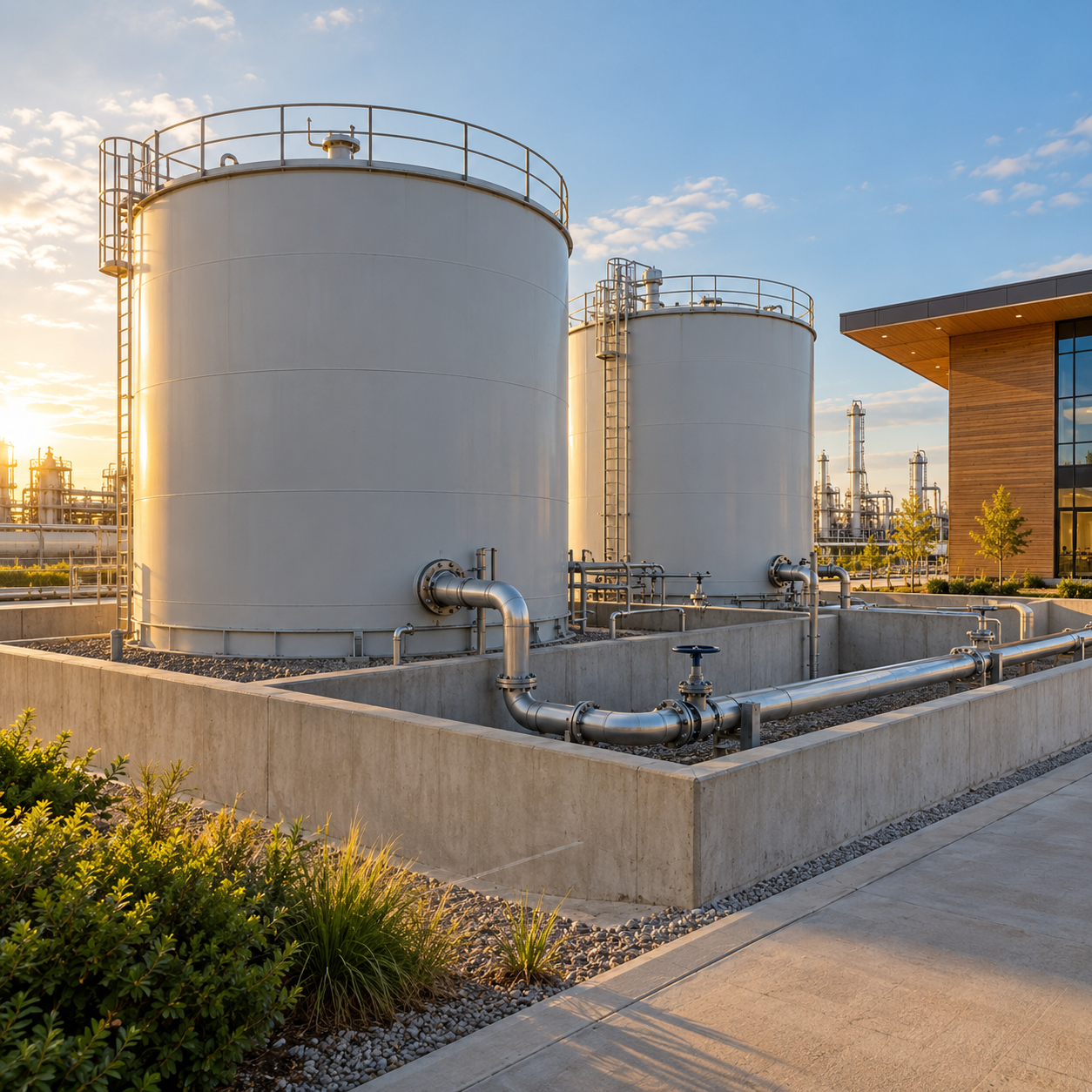
Crude Oil and Product Storage Tanks
Water can accumulate in crude oil and refined-product storage tanks through the incoming product, condensation, tank operations and other process sources.
An automatic decantation valve can allow the settled water phase to be removed while helping to prevent the following oil phase from continuing into the drainage system.
Reclaimed Oil Tanks
Oil recovered from spills, sumps and API separators is often transferred to reclaimed oil tanks together with significant quantities of water and suspended material.
After the phases have settled, automatic decantation can reduce the operator time required to remove the accumulated water and help retain the recoverable oil phase.
Learn more about liquid recovery and decantation in oil refining applications.
Floating Roof Tank Drainage
Rainwater must be removed from floating roof tanks to prevent excessive loading of the roof.
At the same time, a failure within the articulated roof drain or hose can create a route for stored product to escape.
A Belfield Valve fitted to the tank-side drain can allow rainwater to pass while responding to a change from water to the lighter stored product.
A suitable swan-neck or S-bend arrangement may be used to maintain the correct liquid conditions within the valve and prevent unwanted siphoning.
Read more about Belfield Valve floating roof drain applications.
Effluent and Environmental Protection
Where process water is discharged towards an effluent treatment plant, an automatic decantation valve can provide an additional mechanical safeguard against the unintended release of oil, solvents or other lighter liquids.
It should form part of a properly designed drainage and containment system rather than being treated as a substitute for site procedures, monitoring or statutory environmental controls.
Chemical and Pharmaceutical Processing
Automatic decantation can also be used after batch settling and washing stages involving two liquid phases.
Examples can include water paired with toluene, xylene, naphtha, petroleum spirit and other organic liquids.
Compatibility, temperature, specific gravity and process safety must be reviewed for every liquid combination. Similar-looking liquids can have very different chemical manners. Molecules, rather rudely, refuse to respect marketing generalisations.
Automatic Decantation Compared with Manual Tank Drainage
Manual drainage may remain appropriate for occasional, closely supervised operations.
However, its accuracy depends on the operator being present and correctly identifying the interface.
Automatic decantation changes the process from one based primarily on visual judgement to one based on the physical properties of the liquids.
Potential advantages include:
- Reduced dependence on operator observation
- More consistent tank-drainage cycles
- Lower risk of valuable product entering the drain
- Reduced risk of hydrocarbons reaching an effluent system
- Less routine operator attendance
- Mechanical operation without external power for the basic valve function
For sites requiring remote status information, an optional magnetic proximity arrangement can be used to indicate whether the float is in the raised or lowered position.
This can support remote indication or alarm functions when incorporated into a suitable site control system.
When Is a Decantation Valve Not the Right Solution?
Automatic decantation is not suitable for every oil and water problem.
PMA may advise against an application where:
- The phases have not separated before entering the valve
- A stable emulsion is present
- The liquid is extremely viscous or likely to solidify
- Wax or sticky deposits may restrict the float
- The flow is too low for the solids present
- The pressure drop could cause the liquid to flash into vapour
- Temperature changes cause the specific gravities to become too similar
- The process requires a conventional tight shut-off isolation valve
Identifying an unsuitable application before equipment is supplied is part of proper engineering support.
A valve that is excellent at the wrong job is still the wrong valve.
Frequently Asked Questions About Decantation
What Is Decantation Used For?
Decantation is used to separate settled liquid phases with different densities, or to remove a liquid from settled solids.
In industrial storage tanks, it is commonly used to drain water from oil, recover hydrocarbons, separate organic and aqueous phases and protect downstream effluent systems.
What Is the Purpose of Decanting?
The purpose of decanting is to remove one settled phase while retaining another.
In an oil storage tank, this normally means removing the denser water phase while keeping the lighter oil product in the tank or recovery system.
What Is the Difference Between Filtration and Decantation?
Filtration passes a liquid or gas through a filter medium to remove suspended particles.
Decantation relies on gravity and density differences after the materials have settled.
A filter is normally used for solid and fluid separation. A decantation valve can be used for two settled liquid phases, such as oil and water.
What Are Five Examples of Decantation?
Five industrial examples include:
- Draining settled water from a crude oil storage tank
- Removing water from a reclaimed oil tank
- Draining rainwater from a floating roof tank
- Separating an organic solvent from an aqueous wash phase
- Removing settled water from hydraulic or quench oil before recovery
What Is Another Name for Decantation?
Depending on the application, decantation may also be described as phase draw-off, liquid phase separation, gravity separation or tank dewatering.
These expressions are not always technically identical, so the actual process arrangement should be checked rather than relying on the label alone.
What Are Common Decantation Mistakes?
Common mistakes include failing to allow enough settling time, assuming the interface will always be visible, ignoring temperature-related density changes, selecting equipment solely by pipe size and using a decantation valve where inline separation is actually required.
Incorrect pipework, excessive downstream restriction, unsuitable flow conditions and poor float ballasting can also affect performance.
Can Oil and Water Be Separated Automatically?
Yes, provided the oil and water can first settle into distinct phases.
The heavier phase can then be automatically decanted using a device such as the Belfield Valve, which responds to the difference in specific gravity between the liquids.
Does the Belfield Valve Require Electrical Power?
No electrical power is required for the valve’s basic mechanical decantation function.
An electrical supply is only needed where an optional proximity sensor or associated remote indication system is fitted.
Discuss Your Storage Tank Application with PMA
A successful automatic decantation system begins with accurate process information.
Before recommending a Belfield Valve, PMA can review the liquid specific gravities, operating temperatures, viscosity, required flow, available head, solids content and proposed pipework arrangement.
Explore the Belfield Decantation Valve on the PMA website, view our wider range of industrial and oil and gas process solutions, or contact the PMA team to discuss your application.
You can also view the complete Belfield Valve product overview for further information about operation, construction and available configurations.