

Specific gravity is a ratio comparing the mass of a given liquid volume with the mass of an equal water volume at stated reference temperatures. It has no unit, and the reference basis matters when data sheets are compared. NIST includes the temperature basis in its definition.
For a Belfield Valve, the operating principle uses a change in the liquid reaching the float. Liquid identity, temperature, viscosity, solids and the complete hydraulic arrangement still matter. This guide explains what the term contributes and what it cannot tell you.
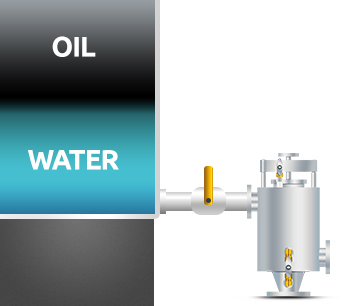
How specific gravity affects oil-water decantation
Start with the two phases, not a single density value
A tank application involves at least two relevant liquids: the heavier phase intended to drain and the lighter phase intended to remain or be recovered. Provide the identity and specific gravity of both, not just the density of the water or the product name.
Ask how each value was obtained, at what temperature and whether it represents the current process. Crude blends, reclaimed oil, brine and contaminated water can vary. If composition changes between batches or suppliers, record a representative range rather than a convenient average.
If a value is estimated or copied from an old data sheet, label it as such. The application reviewer needs to distinguish measured property data from a project assumption before treating the pair as suitable.
Understand the role of the float
The Belfield Valve uses the differential specific gravity of separated liquids to operate its float mechanism. In a suitable duty, the heavier liquid passes through the main outlet; when the lighter phase reaches the mechanism, the float response closes that outlet.
This is a mechanical interface response, not a laboratory density instrument. It does not identify every possible contaminant, break a stable emulsion or guarantee a precise detection threshold for any pair of liquids.
The manufacturer describes its principle and performance in published documentation. That description should be read together with the model, temperature, viscosity, head and installation details. A schematic explains operation but does not confirm an application.
Temperature can change the picture
Specific gravity is tied to temperature because liquid density can change as a process warms or cools. At the same time, viscosity may change significantly, particularly for products that thicken at lower temperature or contain wax.
Report minimum, normal and maximum temperatures, including startup, shutdown and stagnant conditions where those occur. Provide the source of the property data and the temperature to which it applies. A single ambient value may be a poor proxy for a hot tank or a cold start.
If a change in temperature could bring the two liquids closer together or make the lighter liquid much more viscous, ask for an application review. Do not assume that a float setting or nominal capacity from one condition automatically transfers to another.
Do not turn a density difference into a flow prediction
Specific gravity contributes to the valve response and flow, but the site rate also depends on head, viscosity, temperature, float ballasting and pipework. The manufacturer presents nominal capacity at a reference head and gives additional performance guidance for defined conditions.
A tank with a larger density difference is not automatically a better installation if it has very low head, a restrictive inlet or a high back pressure. Similarly, a model with a larger published capacity does not fix an unsuitable liquid pair or a blocked receiving route.
Treat model selection as a calculation and design review, not a single lookup. The current sizing guide lists the related data and states that published model data prepares an enquiry rather than making an automatic selection.
Measure and communicate values responsibly
Use consistent units and identify whether the number is specific gravity, relative density or density with a unit. Provide both phases and the measurement temperature. If the source gives a curve, send the curve rather than reducing it to one point.
Attach safety data and note water salinity, additives, suspended solids or intermediate layers where relevant. A representative sample can support an assessment, but the sample method and the point in the operating cycle should be documented.
When values are unknown, ask what sampling or laboratory method is suitable for the process. Do not handle a hazardous sample or change an operating condition outside approved site procedures.
- Name of each liquid phase and composition range
- Specific gravity or density for both phases and units
- Measurement temperature and data source
- Normal and extreme operating temperatures
- Viscosity, solids, emulsion and wax notes
- Head, required flow and a current piping sketch
Use the numbers as one part of the selection
The full application review joins liquid properties to the tank and drain arrangement. Include available head at the lowest and highest tank levels, flow target, inlet and outlet sizes, downstream resistance, venting, valves and intended receiving point.
For a pumped arrangement, high head or an unfamiliar liquid pair, include the pump and process diagrams. Product guidance identifies conditions that require individual factory review. Do not calculate a correction from a brief article when the manufacturer says a particular duty needs case specific assessment.
A useful enquiry ends with a decision record: the property data accepted, any remaining assumptions, the model and materials reviewed, and the conditions that would trigger a new assessment. Keep that record with the approved drawing and operating procedure.
When a product blend, water composition or operating temperature changes, revisit the values rather than reusing the old selection sheet unchanged. A recorded source and measurement condition make it possible to tell whether a new value represents a genuine process change or simply a different reference basis.
Frequently asked questions
Is specific gravity the same as API gravity?
They are different ways of describing liquid properties and should not be substituted without conversion and the correct reference conditions. Send the original property and its units to the application reviewer.
Does a larger density difference guarantee a suitable valve?
No. It is one input. Temperature, viscosity, phase behaviour, head, solids, flow and pipework also affect suitability and performance.
Should I provide values at room temperature?
Provide the measurement temperature and the actual operating range. Room temperature data may not represent startup, shutdown or hot operation.
Can the valve split an oil-water emulsion?
The published operating principle is based on separated phases and a change in the liquid reaching the float. A stable emulsion needs a separate process assessment.
Sources and further reading
See the Belfield performance data and selection guide for product specific context.
The Belfield operating brochure describes the differential specific gravity principle. NIST defines specific gravity for liquids as a comparison with an equal volume of water at a stated reference temperature.
Next steps
For a selection review, send both liquid values, measurement temperatures and the full operating envelope through the Belfield contact page. For more about PMA, visit the PMA website.